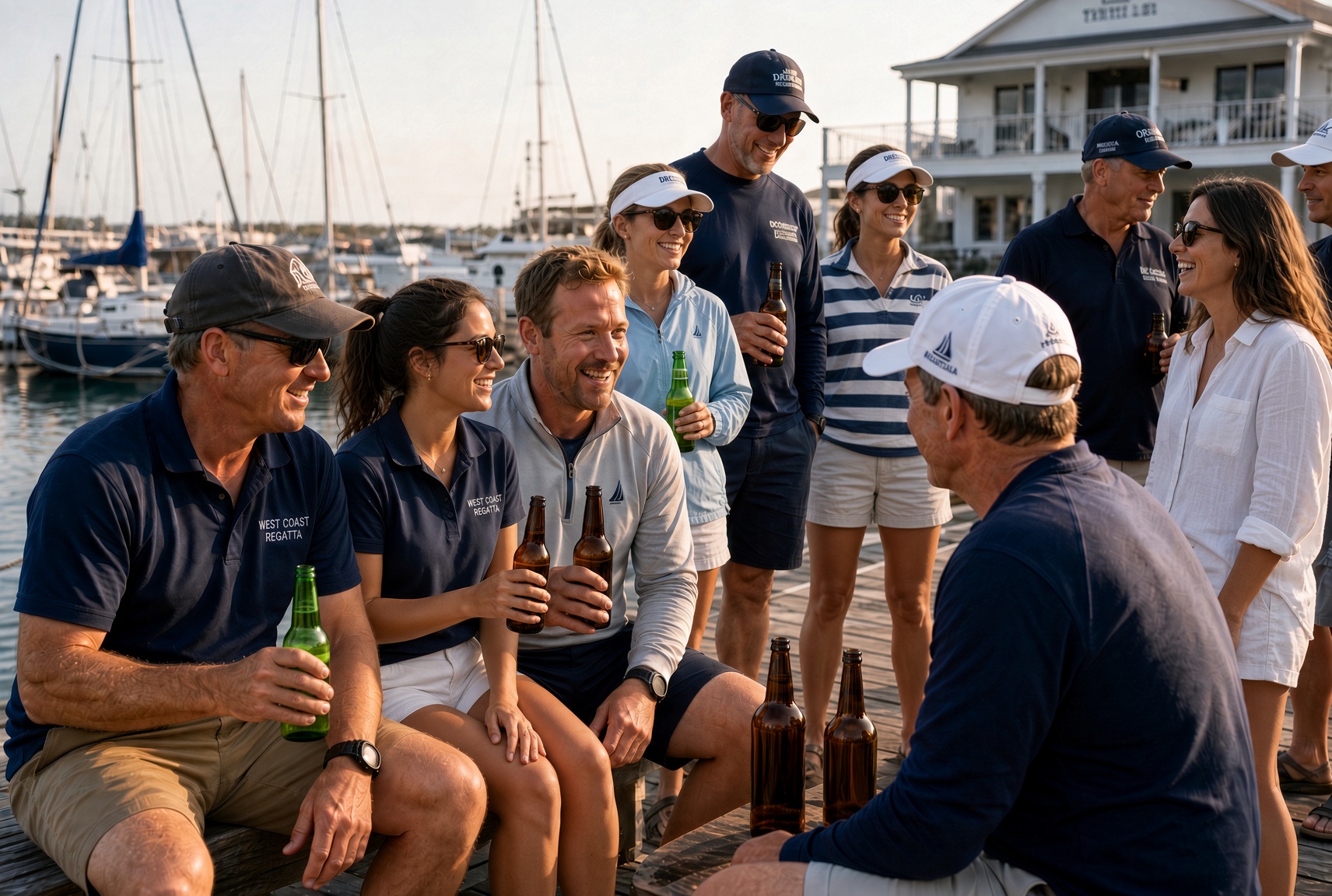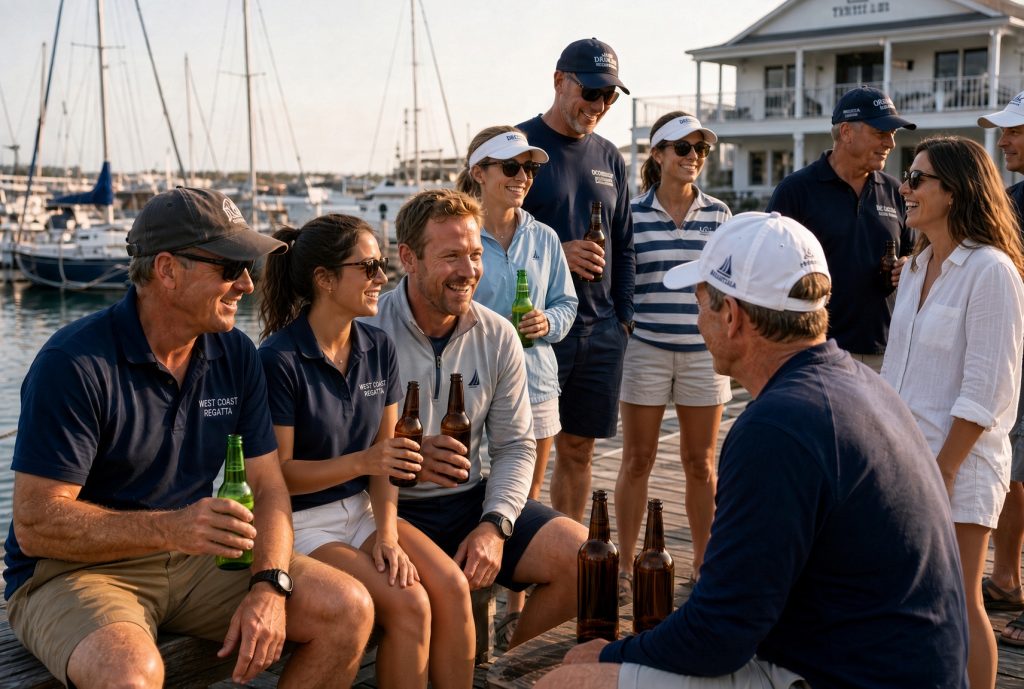
Sailboat racing has its own version of the society’s constant inclusion (worship?) of alcohol. The race ends, the boats come in, and the expectation is that the real event is just beginning. Après-racing is not an after-thought. It is the fabric that holds the community together: dockside gatherings, yacht club bars, shared rounds, and the assumption that everyone will participate. Alcohol manufacturers have long treated the sport as a natural home. Mount Gay Rum, for example, has sponsored regattas for decades—Cowes Week, the BVI Spring Regatta, Charleston Race Week, events in Barbados, and others—often with dedicated bars, free pours after racing, bottles handed to podium finishers and lots and lots of swag. The brand’s connection to sailing is repeatedly described as part of its identity, not a side sponsorship.
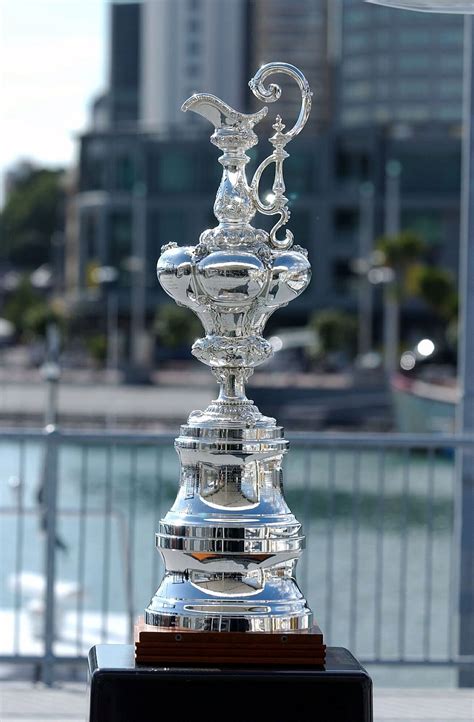 The culture is older and deeper than any single sponsor. Casual midweek series are still widely called beer-can races. The name is not ironic. Post-race gatherings at the club or on the dock are built around the expectation that the day ends with a drink in hand. Winning boats are sometimes awarded beer mugs, crystal glassware, or bottles. Even the America’s Cup itself is a silver ewer historically nicknamed the “Auld Mug.” The trophy is a drinking vessel. The symbolism is not subtle: the achievement is meant to be marked by pouring something into it.
For someone who does not drink—whether in recovery, for health reasons, or by choice—the structure creates friction at every stage. The race itself can still be clean. Once the boats are tied up, the social contract shifts. Declining a drink after a hard race is not a neutral act. It can register as distance, as judgment, or as a refusal to fully join the group that just spent the day competing together. Friends and competitors may not intend pressure when they offer a beer or a rum, but the offer is repeated often enough that the person who has already decided the cost is too high still has to manage it in real time. The isolation is practical. Conversations move to the bar. Photos are taken with trophies that are mugs or glasses. The person who stays clear-headed can feel as if they have finished the race but missed the part that counts as belonging.
None of this requires treating the sport as closed. People still sail, still race, and still want the camaraderie that comes with it. The difficulty is that the culture has made alcohol the primary language of that camaraderie. A sober sailor can still show up for the start, still crew, still celebrate a good finish with the people who were on the boat. What is harder is remaining fully present once the default shifts from the race to the pour. The presence of long-standing sponsors, the naming of entire series after beer, and the form of the trophies themselves all reinforce the same premise: the full experience includes the drink.
That premise is not universal, even if it feels that way on the dock. Some sailors have always preferred the race itself to the aftermath. Others have decided, for reasons that are personal and non-negotiable, that the aftermath cannot include alcohol. The decision does not erase the love of the sport or the desire to be part of the community. It simply means the community’s default setting requires active management. The race can still be raced. The boat can still be sailed. The people who matter can still be there. The part that has to be negotiated, again and again, is the assumption that the day is incomplete without the mug being filled.