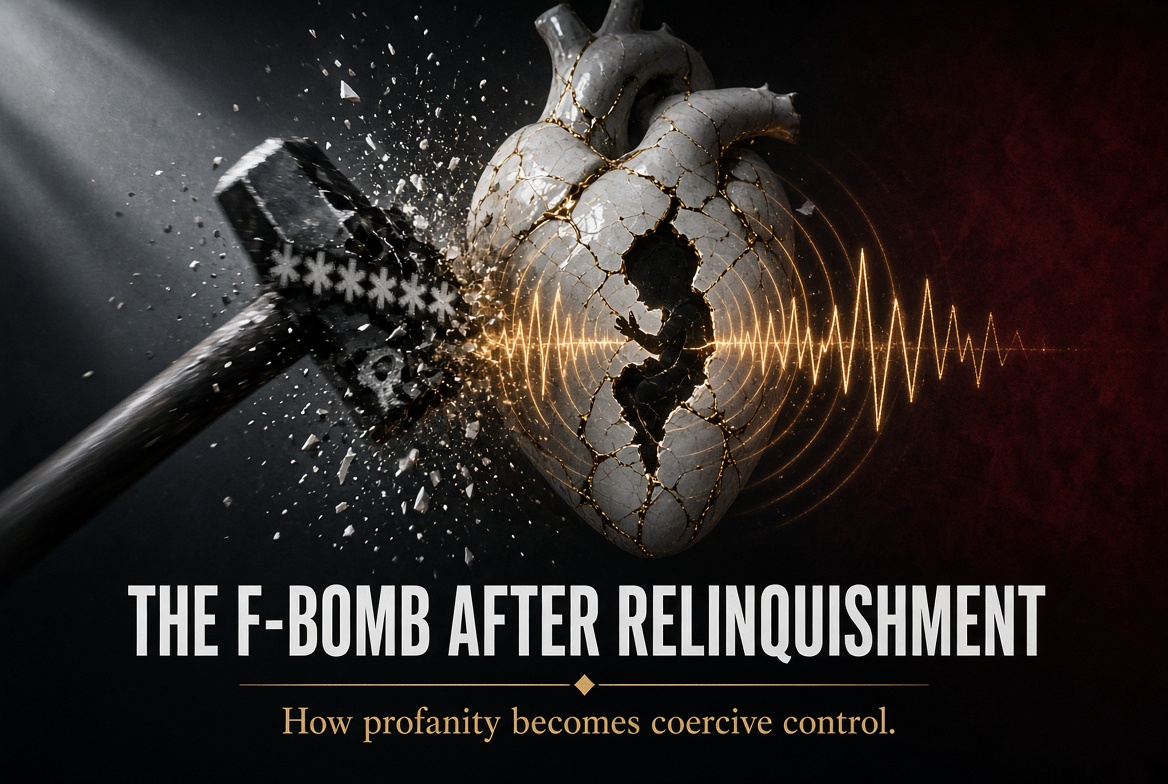
Profanity is rarely just color. In many conversations it functions as a blunt instrument: a way to shock the system, seize the floor, and tilt the power balance before the other person can think. What looks like raw emotion is often a calculated move.
Psychological research has long shown that taboo language does not land like ordinary speech. Hearing or reading a strong swear word produces an immediate, involuntary autonomic response—elevated heart rate and increased skin conductance, a spike in arousal that resembles a miniature fight-or-flight reaction. The brain treats the word as a social threat. That reaction happens faster than deliberate reasoning. A speaker who understands this can use it on purpose.
Drop the taboo word at the right moment and the listener’s attention snaps to the insult rather than the argument. Cognitive resources that should be evaluating evidence get diverted into managing the jolt. In that brief window the speaker can reframe the issue, issue a demand, or shut down dissent. This is remote aggression. No raised fist is required. Over time the pattern can become coercive control: the same person who “just gets passionate” when challenged also decides when the conversation ends.
For people who were relinquished and later adopted, the same tactic often cuts deeper. Relinquishment is a primal separation. Many adoptees carry heightened rejection sensitivity, hypervigilance to relational threat, and a nervous system already trained to scan for signs of being unwanted or discarded. Verbal aggression—including profanity used to dominate—does not arrive as a neutral expletive. It can land as a second wound: the original loss plus a present-tense message that closeness is unsafe and dissent will be punished.
Research on verbal abuse shows it can alter developing threat circuitry and increase later anxiety, depression, and limbic irritability. Combined with adoption-related attachment injury, the effect is compounding. Words that imply defect, illegitimacy, or “you should be grateful” already exist as common adoption microaggressions. When those themes are delivered with shock language, the body may respond as if abandonment is happening again—not as metaphor, but as physiology. Compliance can look like safety. Silence can look like survival.
None of this means every curse is a plot, or that every adoptee will react the same way. People swear when startled or genuinely furious. Context and pattern matter. A single expletive in a high-stress moment is different from a speaker who reaches for the strongest available language whenever they are losing ground.
Recognizing the move does not require becoming a prude. It requires noticing the function. When language is used to overwhelm rather than to clarify, the conversation has left collaboration. Naming the tactic quietly—“That’s not an argument, that’s a shock”—and refusing to let the arousal dictate the next move is often the most effective response. The physiological spike fades. The attempt to hijack the interaction does not have to succeed.
Words remain tools. Some people use them to build understanding. Others use them to break resistance. For anyone whose earliest story already included being given away, the difference is not academic. It is felt in the body first.
Selected scientific literature
Harris, C. L., Ayçiçeği, A., & Gleason, J. B. (2003). Taboo words and reprimands elicit greater autonomic reactivity in a first language than in a second language. Applied Psycholinguistics, 24(4), 561–579.
Stephens, R., Atkins, J., & Kingston, A. (2009). Swearing as a response to pain. NeuroReport, 20(12), 1056–1060.
Janschewitz, K. (2008). Taboo, emotionally valenced, and emotionally neutral word norms. Behavior Research Methods, 40(4), 1065–1074.
Teicher, M. H., Samson, J. A., Polcari, A., & McGreenery, C. E. (2006). Sticks, stones, and hurtful words: Relative effects of various forms of childhood maltreatment. American Journal of Psychiatry, 163(6), 993–1000.
Teicher, M. H., Samson, J. A., Sheu, Y. S., Polcari, A., & McGreenery, C. E. (2010). Hurtful words: Association of exposure to peer verbal abuse with elevated psychiatric symptom scores and corpus callosum abnormalities. American Journal of Psychiatry, 167(12), 1464–1471.
Baden, A. L. (2016). “Do you know your real parents?” and other adoption microaggressions. Adoption Quarterly, 19(1), 1–25.
Dalton, N., McLaughlin, M., & Cassidy, T. (2022). Attachment state of mind and trauma in mother and baby home adoptees. Adoption & Fostering, 46(2).
Kenny, P., Higgins, D., & colleagues (synthesized in later reviews). Psychological implications of forced adoption: attachment difficulties, identity loss, and heightened sensitivity to rejection among adoptees. See also the 2025 scoping review in Acta Psychologica.